darknet53#
Overview#
Darknet-53 is a convolutional neural network architecture that serves as the backbone for the YOLOv3 (You Only Look Once) object detection system. It was introduced by Joseph Redmon and Ali Farhadi in their paper “YOLOv3: An Incremental Improvement.” Darknet-53 is an improvement over its predecessor, Darknet-19, offering better performance and accuracy while maintaining efficiency suitable for real-time applications.
Architecture#
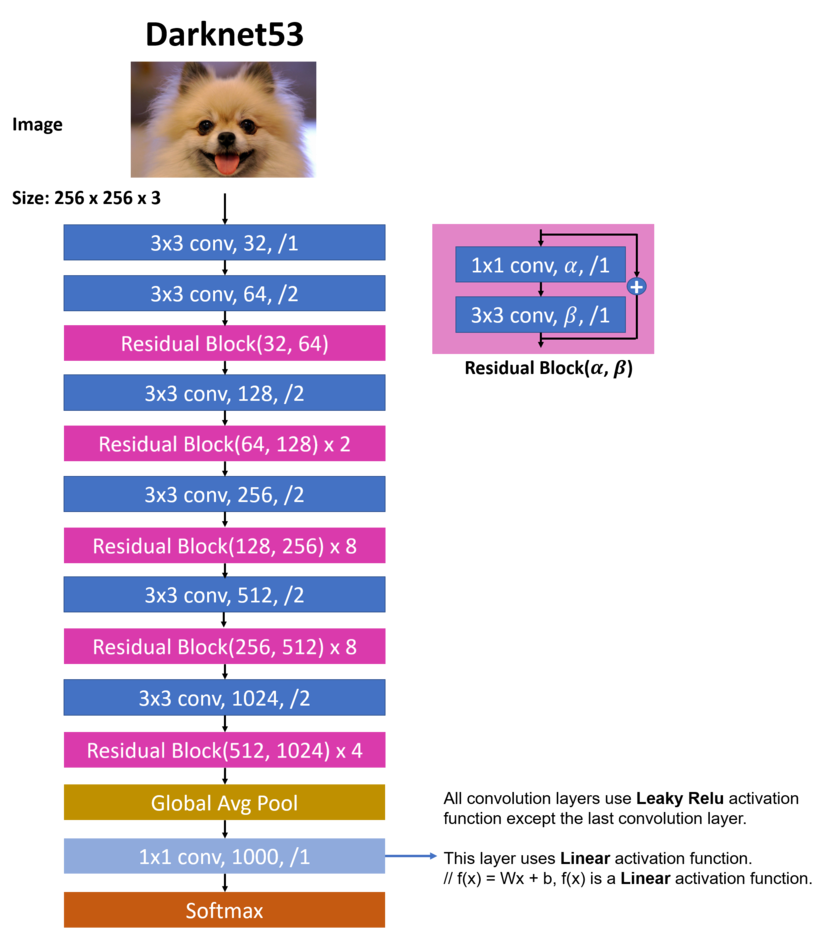
The architecture of Darknet-53 consists of 53 convolutional layers. It uses a combination of 3x3 and 1x1 convolutional filters and employs residual connections similar to those in ResNet. This design helps mitigate the vanishing gradient problem, allowing for the training of deeper networks.
Key Features:#
53 convolutional layers: Ensures deep feature extraction capability.
Residual connections: Facilitates gradient flow, enabling the training of deeper networks.
Efficient structure: Balances accuracy and speed, making it suitable for real-time applications.
Math in LaTeX#
In LaTeX, the convolution operation for a given layer can be represented as:
Where:
(Y) is the output feature map
(f) is the activation function (ReLU in many cases)
(W) is the weight of the convolutional kernel
(X) is the input feature map
(b) is the bias term
(*) denotes the convolution operation
Real-World Example#
One of the notable applications of Darknet-53 is in the YOLOv3 object detection system. YOLOv3 can process images and detect objects in real time, making it highly valuable in various fields such as:
Autonomous driving: Detecting pedestrians, vehicles, and obstacles.
Surveillance systems: Real-time monitoring and threat detection.
Robotics: Enabling robots to understand and interact with their environment.
Retail: Analyzing customer behavior and enhancing security.
Practical Insights#
Darknet-53 balances depth and computational efficiency, allowing for the detection of small and large objects in images. The use of residual connections helps in training deeper networks, which is crucial for extracting detailed features from images. This architecture is designed to work seamlessly with YOLOv3, providing a robust framework for object detection tasks.
Conclusion#
Darknet-53 represents a significant step forward in the design of convolutional neural networks for object detection. Its efficient architecture and use of residual connections make it a powerful tool for real-time applications, providing a good balance between performance and computational cost.