SVC#
simple SVC#
        oSvmCls     = SVC(C = C, kernel = 'linear')

    ...
    oSvmCls     = oSvmCls.fit(mXTrain, vYTrain)
    accScore    = oSvmCls.score(mXTest, vYTest)
    ...
kernels#
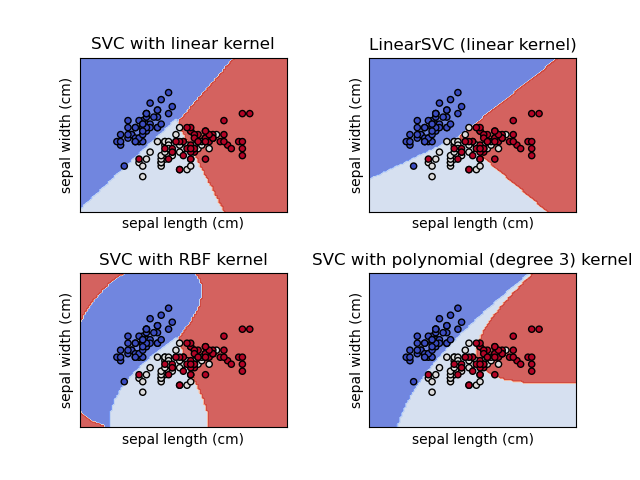
LinearSVC#
LinearSVCclass which optimizedSVCwith kernellinearas it fits for larger data sets
When using LinearSVC:
* If #Samples > #Features -> Set dual = False.
* If #Samples < #Features -> Set dual = True (Default).
oSvmCls = LinearSVC(C = C, max_iter = maxItr, dual = False)
plot area#
# Grid of the data support
v0       = np.linspace(mX[:, 0].min(), mX[:, 0].max(), numGridPts)
v1       = np.linspace(mX[:, 1].min(), mX[:, 1].max(), numGridPts)
XX0, XX1 = np.meshgrid(v0, v1)
XX       = np.c_[XX0.ravel(), XX1.ravel()]

Z = oSVM.predict(XX)
Z = Z.reshape(XX0.shape)

hF, hA = plt.subplots(figsize = FIG_SIZE_DEF)
hA.contourf(XX0, XX1, Z, colors = CLASS_COLOR, alpha = 0.3, levels = [-0.5, 0.5, 1.5])
option:: probability#
in order to have the probability per class on the SVC class we need to set
probability = True.probability = Trueis not always consistent with thedecision_function()method. Hence it is better to use it in the case of theSVC
https://scikit-learn.org/stable/modules/svm.html#scores-probabilities
enables the estimation of class probabilities for the predictions
This option allows you to call the predict_proba and predict_log_proba methods of the SVC - which give you the probability estimates for each class.
Use Cases:
Binary and Multiclass Classification: Probability estimates can be particularly useful in binary classification for understanding the likelihood of the positive class. They are also valuable in multiclass scenarios to assess confidence across multiple classes.
Threshold Adjustment: In applications where the decision threshold needs to be adjusted away from the default 0.5 (for binary classification), having probability estimates allows for more nuanced control over classification decisions.
Risk Assessment: In fields like finance or healthcare, understanding the probability of certain outcomes can be as important as the outcomes themselves for risk assessment and decision-making processes.
Ensemble Methods: Probabilities can be used in ensemble learning methods that require them, such as stacking classifiers, where the predictions of several models are combined.