
AI Program#
Machine Learning - Supervised Learning - Regression - Polynomial Fit - Exercise#
Notebook by:
Royi Avital RoyiAvital@fixelalgorithms.com
Revision History#
Version |
Date |
User |
Content / Changes |
|---|---|---|---|
1.0.000 |
23/03/2024 |
Royi Avital |
First version |

# Import Packages

# General Tools
import numpy as np
import scipy as sp
import pandas as pd

# Machine Learning
from sklearn.base import BaseEstimator, RegressorMixin
from sklearn.linear_model import LinearRegression
from sklearn.preprocessing import PolynomialFeatures

# Miscellaneous
import math
import os
from platform import python_version
import random
import timeit

# Typing
from typing import Callable, Dict, List, Optional, Set, Tuple, Union

# Visualization
import matplotlib as mpl
import matplotlib.pyplot as plt
import seaborn as sns

# Jupyter
from IPython import get_ipython
from IPython.display import Image
from IPython.display import display
from ipywidgets import Dropdown, FloatSlider, interact, IntSlider, Layout, SelectionSlider
from ipywidgets import interact
Notations#
(?) Question to answer interactively.
(!) Simple task to add code for the notebook.
(@) Optional / Extra self practice.
(#) Note / Useful resource / Food for thought.
Code Notations:
someVar    = 2; #<! Notation for a variable
vVector    = np.random.rand(4) #<! Notation for 1D array
mMatrix    = np.random.rand(4, 3) #<! Notation for 2D array
tTensor    = np.random.rand(4, 3, 2, 3) #<! Notation for nD array (Tensor)
tuTuple    = (1, 2, 3) #<! Notation for a tuple
lList      = [1, 2, 3] #<! Notation for a list
dDict      = {1: 3, 2: 2, 3: 1} #<! Notation for a dictionary
oObj       = MyClass() #<! Notation for an object
dfData     = pd.DataFrame() #<! Notation for a data frame
dsData     = pd.Series() #<! Notation for a series
hObj       = plt.Axes() #<! Notation for an object / handler / function handler
Code Exercise#
Single line fill
vallToFill = ???
Multi Line to Fill (At least one)
# You need to start writing
????
Section to Fill
#===========================Fill This===========================#
# 1. Explanation about what to do.
# !! Remarks to follow / take under consideration.
mX = ???

???
#===============================================================#
# Configuration
# %matplotlib inline

seedNum = 512
np.random.seed(seedNum)
random.seed(seedNum)

# Matplotlib default color palette
lMatPltLibclr = ['#1f77b4', '#ff7f0e', '#2ca02c', '#d62728', '#9467bd', '#8c564b', '#e377c2', '#7f7f7f', '#bcbd22', '#17becf']
# sns.set_theme() #>! Apply SeaBorn theme

runInGoogleColab = 'google.colab' in str(get_ipython())
# Constants

FIG_SIZE_DEF    = (8, 8)
ELM_SIZE_DEF    = 50
CLASS_COLOR     = ('b', 'r')
EDGE_COLOR      = 'k'
MARKER_SIZE_DEF = 10
LINE_WIDTH_DEF  = 2

PEOPLE_CSV_URL = 'https://github.com/FixelAlgorithmsTeam/FixelCourses/raw/master/DataSets/People.csv'
# Courses Packages
import sys
sys.path.append('../')
sys.path.append('../../')
sys.path.append('../../../')
from utils.DataVisualization import PlotRegressionData, PlotRegressionResults
# General Auxiliary Functions

def PolyModelString( vW: np.ndarray, applyLatex: bool = True ) -> str:

    latexDelimiter = '$' if applyLatex else ''

    modelTxt = latexDelimiter + 'y = '
    for ii in range(len(vW)):
        modelTxt += f'({vW[ii]:0.3f}) {{x}}^{{{ii}}} + '

    modelTxt = modelTxt[:-2]
    modelTxt += latexDelimiter

    return modelTxt
Polynomial Fit#
In this exercise we’ll build an estimator with the Sci Kit Learn API.
The model will employ a 1D Polynomial fit of degree P.
We’ll us the People.csv data set.
It includes 1000 samples of peoples: Sex, Age, Height (CM), Weight (KG).
The objective is to estimate the weight given the height.
I this exercise we’ll do the following:
Load the
People.csvdata set usingpd.csv_read().Create a an estimator (Regressor) class using SciKit API:
Implement the constructor.
Implement the
fit(),predict()andscore()methods.
Verify the estimator vs.
np.polyfit().Display the output of the model.
(#) In order to let the classifier know the data is binary / categorical we’ll use a Data Frame as the data structure.
# Parameters

# Model
polynomDeg = 2

# Data Visualization
gridNoiseStd = 0.05
numGridPts = 250
Generate / Load Data#
Loads the online csv file directly as a Data Frame.
# Load Data

dfPeople = pd.read_csv(PEOPLE_CSV_URL)

dfPeople.head(10)
| Sex | Age | Height | Weight | |
|---|---|---|---|---|
| 0 | f | 26 | 171.1 | 57.0 |
| 1 | m | 44 | 180.1 | 84.7 |
| 2 | m | 32 | 161.9 | 73.6 |
| 3 | m | 27 | 176.5 | 81.0 |
| 4 | f | 26 | 167.3 | 57.4 |
| 5 | m | 56 | 165.9 | 72.1 |
| 6 | f | 47 | 169.6 | 58.7 |
| 7 | f | 45 | 179.9 | 64.0 |
| 8 | f | 37 | 168.9 | 62.6 |
| 9 | m | 42 | 168.6 | 77.7 |
Plot Data#
# Pair Plot

sns.pairplot(data = dfPeople, hue = 'Sex')
<seaborn.axisgrid.PairGrid at 0x7f91a83a12d0>
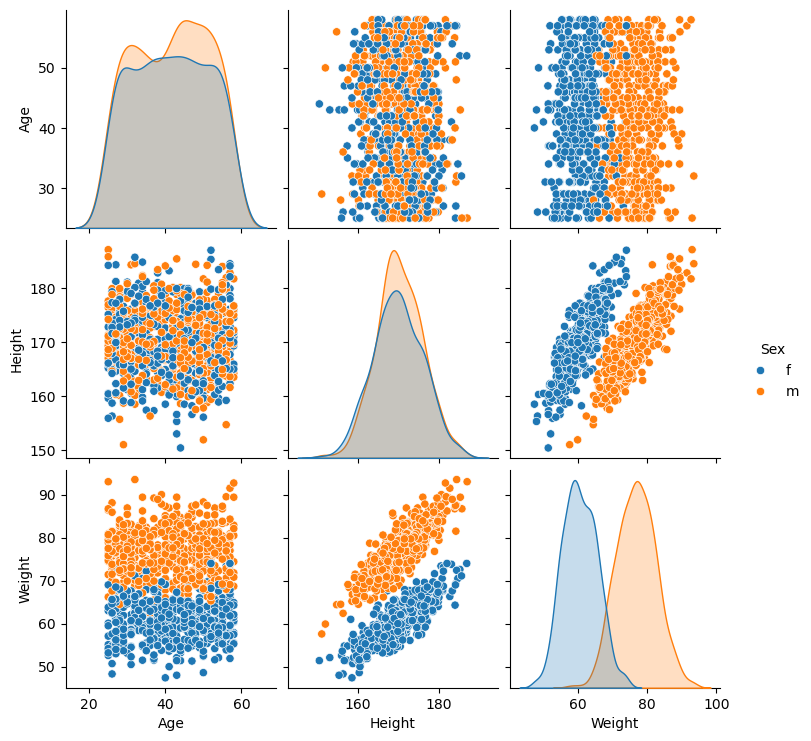
(?) How would you model the data for the task of estimation of the weight of a person given his sex, age and height?
# The Training Data

#===========================Fill This===========================#
# 1. Extract the 'Height' column into a series `dsX`.
# 2. Extract the 'Weight' column into a series `dsY`.
dsX = dfPeople['Height'].copy()
dsY = dfPeople['Weight'].copy()
#===============================================================#

print(f'The features data shape: {dsX.shape}')
print(f'The labels data shape: {dsY.shape}')
The features data shape: (1000,)
The labels data shape: (1000,)
# Plot the Data

PlotRegressionData(dsX.to_numpy(), dsY.to_numpy())

plt.show()
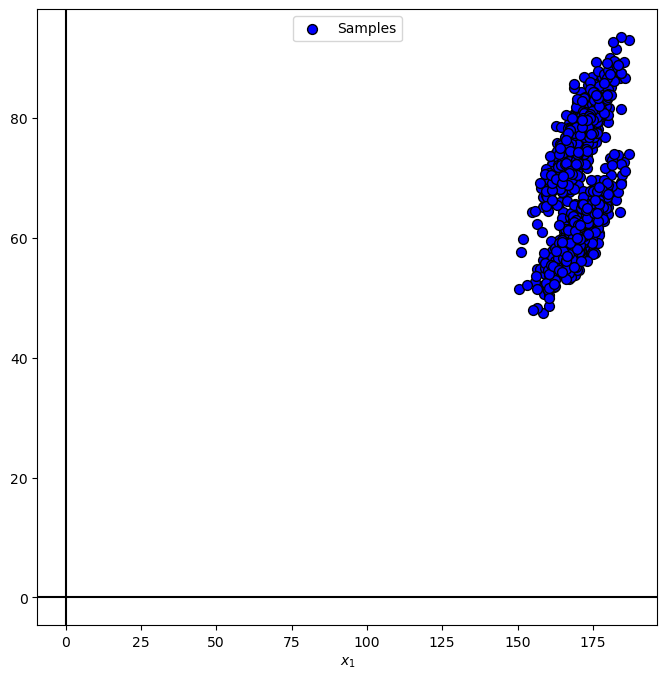
(?) Which polynomial order fits the data?
Polyfit Regressor#
The PolyFit optimization problem is given by:
Where
This is a polyfit with hyper parameter \(p\).
The optimal weights are calculated by linear system solvers.
Yet it is better to use solvers optimized for this task, such as:
NumPy:
polyfit.SciKit Learn:
LinearRegressioncombined withPolynomialFeatures.
In this notebook we’ll implement our own class based on SciKit Learn’s solutions.
(#) For arbitrary \(\Phi\) the above becomes a linear regression problem.
Polyfit Estimator#
We could create the linear polynomial fit estimator using a Pipeline of PolynomialFeatures and LinearRegression.
Yet since this is a simple task it is a good opportunity to exercise the creation of a SciKit Estimator.
We need to provide 4 main methods:
The
__init()__Method: The constructor of the object. It should set the degree of the polynomial model used.The
fit()Method: The training phase. It should calculate the matrix and solve the linear regression problem.
class PolyFitRegressor(RegressorMixin, BaseEstimator):
    def __init__(self, polyDeg = 2):
        #===========================Fill This===========================#
        # 1. Add `polyDeg` as an attribute of the object.
        # 2. Add `PolynomialFeatures` object as an attribute of the object.
        # 3. Add `LinearRegression` object as an attribute of the object.
        # !! Configure `PolynomialFeatures` by the `include_bias` parameter
        #    and `LinearRegression` by the `fit_intercept` parameter
        #    in order to avoid setting the constants columns.
        self.polyDeg   = polyDeg
        self.oPolyFeat = PolynomialFeatures(degree = polyDeg, interaction_only = False, include_bias = False)
        self.oLinReg   = LinearRegression(fit_intercept = True)
        #===============================================================#

        pass #<! The `__init__()` method should not return any value!

    def fit(self, mX, vY):

        if np.ndim(mX) != 2:
            raise ValueError(f'The input `mX` must be an array like of size (n_samples, 1) !')

        if mX.shape[1] !=  1:
            raise ValueError(f'The input `mX` must be an array like of size (n_samples, 1) !')

        #===========================Fill This===========================#
        # 1. Apply `fit_transform()` for the features using `oPolyFeat`.
        # 2. Apply `fit()` on the features using `oLinReg`.
        # 3. Extract `coef_`, `rank_`, `singluar_`, `intercept_` and `n_features_in_` from `oLinReg`.
        # 4. Set `vW_`, as the total weights in the order of the matrix Φ above.
        mXX                 = self.oPolyFeat.fit_transform(mX)
        self.oLinReg        = self.oLinReg.fit(mXX, vY)
        self.coef_          = self.oLinReg.coef_
        self.rank_          = self.oLinReg.rank_
        self.singular_      = self.oLinReg.singular_
        self.intercept_     = self.oLinReg.intercept_
        self.n_features_in_ = self.oLinReg.n_features_in_
        self.vW_            = np.concatenate((np.atleast_1d(self.oLinReg.intercept_), self.oLinReg.coef_), axis = 0)
        #===============================================================#

        return self

    def predict(self, mX):

        if np.ndim(mX) != 2:
            raise ValueError(f'The input `mX` must be an array like of size (n_samples, 1) !')

        if mX.shape[1] !=  1:
            raise ValueError(f'The input `mX` must be an array like of size (n_samples, 1) !')

        #===========================Fill This===========================#
        # 1. Construct the features matrix.
        # 2. Apply the `predict()` method of `oLinReg`.
        mXX = self.oPolyFeat.fit_transform(mX)
        vY  = self.oLinReg.predict(mXX)
        #===============================================================#

        return vY

    def score(self, mX, vY):
        # Return the RMSE as the score

        if (np.size(vY) != np.size(mX, axis = 0)):
            raise ValueError(f'The number of samples in `mX` must match the number of labels in `vY`.')

        #===========================Fill This===========================#
        # 1. Apply the prediction on the input features.
        # 2. Calculate the RMSE vs. the input labels.
        vYPred  = self.predict(mX)
        valRmse = np.sqrt(np.mean(np.square(vY - vYPred)))
        #===============================================================#

        return valRmse
(#) The model above will fail on SciKit Learn’s
check_estimator().
It fils since it limits to a certain type of input data (Single column matrix) and other things (Setting attributes in__init__()etc…).
Yet it should work as part of a pipeline.
Training#
In this section we’ll train the model on the whole data using the class implemented above.
# Construct the Polynomial Regression Object

#===========================Fill This===========================#
# 1. Construct the model using the `PolyFitRegressor` class and `polynomDeg`.
oPolyFit = PolyFitRegressor(polyDeg = polynomDeg)
#===============================================================#
# Train the Model

#===========================Fill This===========================#
# 1. Convert `dsX` into a 2D matrix `mX` of shape `(numSamples, 1)`.
# 2. Convert `dsY` into a vector `vY` of shape `(numSamples, )`.
# 3. Fit the model using `mX` and `vY`.
# !! SciKit Learn's model requires input data as 2D array (DF / Matrix).
mX = np.reshape(dsX.to_numpy(), (-1, 1)) #<! NumPy array
vY = dsY.to_numpy() #<! NumPy vector

oPolyFit = oPolyFit.fit(mX, vY)
#===============================================================#
# Model Parameters

# Extract the Coefficients of the model.
vW = oPolyFit.vW_
# Verify Model

vWRef = np.polyfit(dsX.to_numpy(), dsY.to_numpy(), deg = polynomDeg)[::-1]

for ii in range(polynomDeg + 1):
    print(f'The model {ii} coefficient: {vW[ii]}, The reference coefficient: {vWRef[ii]}')

maxAbsDev = np.max(np.abs(vW - vWRef))
print(f'The maximum absolute deviation: {maxAbsDev}') #<! Should be smaller than 1e-8

if (maxAbsDev > 1e-8):
    print(f'Error: The implementation of the model is in correct!')
The model 0 coefficient: -211.41155336386498, The reference coefficient: -211.41155336374274
The model 1 coefficient: 2.512083188841756, The reference coefficient: 2.5120831888403163
The model 2 coefficient: -0.005066608270394755, The reference coefficient: -0.005066608270390533
The maximum absolute deviation: 1.2224177226016764e-10
Display Error and Score#
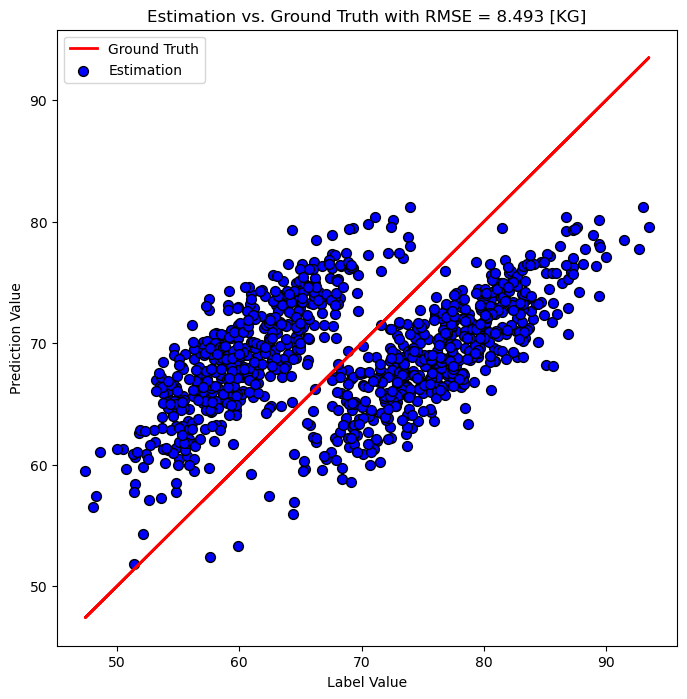
When dealing with regression there is a useful visualization which shows the predicted value vs the reference value.
This allows showing the results regardless of the features number of dimensions.
# Plot the Prediction
hF, hA = plt.subplots(figsize = FIG_SIZE_DEF)

PlotRegressionResults(vY, oPolyFit.predict(mX), hA = hA, axisTitle = f'Estimation vs. Ground Truth with RMSE = {oPolyFit.score(mX, vY):0.3f} [KG]')

plt.show()
Since the features are 1D we can also show the prediction as a function of the input.
# Prediction vs. Features

vXX = np.linspace(120, 220, 2000)
hF, hA = plt.subplots(figsize = FIG_SIZE_DEF)

modelTxt = '$y = '
for ii in range(polynomDeg + 1):
    modelTxt += f'({vW[ii]:0.3f}) {{x}}^{{{ii}}} + '

modelTxt = modelTxt[:-2]
modelTxt += '$'

hA.scatter(dsX.to_numpy(), dsY.to_numpy(), color = 'b', label = 'Train Data')
hA.plot(vXX, oPolyFit.predict(np.reshape(vXX, (-1, 1))), color = 'r', label = 'Model Estimation')
hA.set_title(f'The Linear Regression Model: {modelTxt}')
hA.set_xlabel('$x$ - Height [CM]')
hA.set_ylabel('$y$ - Weight [KG]')
hA.legend()

plt.show()
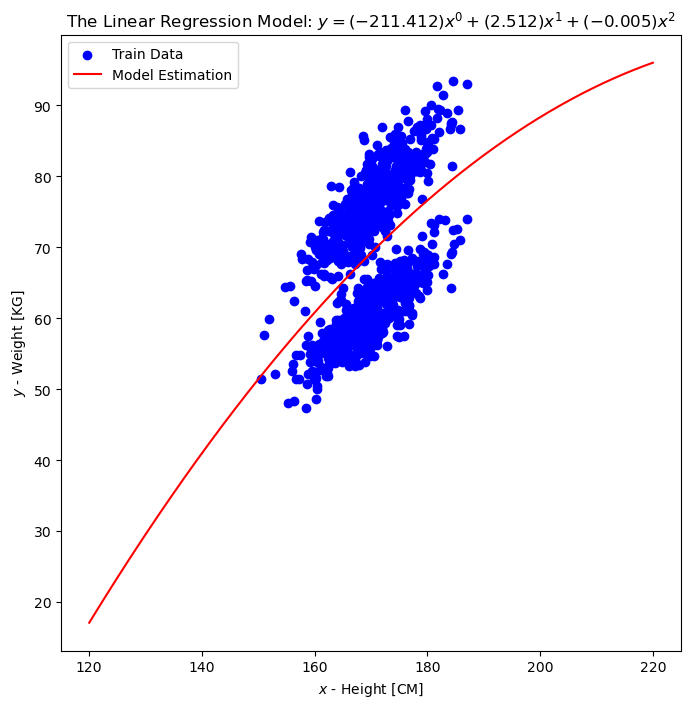
(?) What did the model predict? What should be done?
(!) Try the above with the model order fo 1 and 3.